
The special school squeeze: a third more pupils and six in ten schools over capacity
Six years of GIAS records show demand for special school places outrunning supply
While mainstream primary rolls fall, special schools are filling up. We rebuilt pupil numbers and recorded capacity for every special school in England for each January census from 2020 to 2026, using monthly snapshots of Get Information about Schools (GIAS). The result is a system under growing strain.
A third more pupils in six years
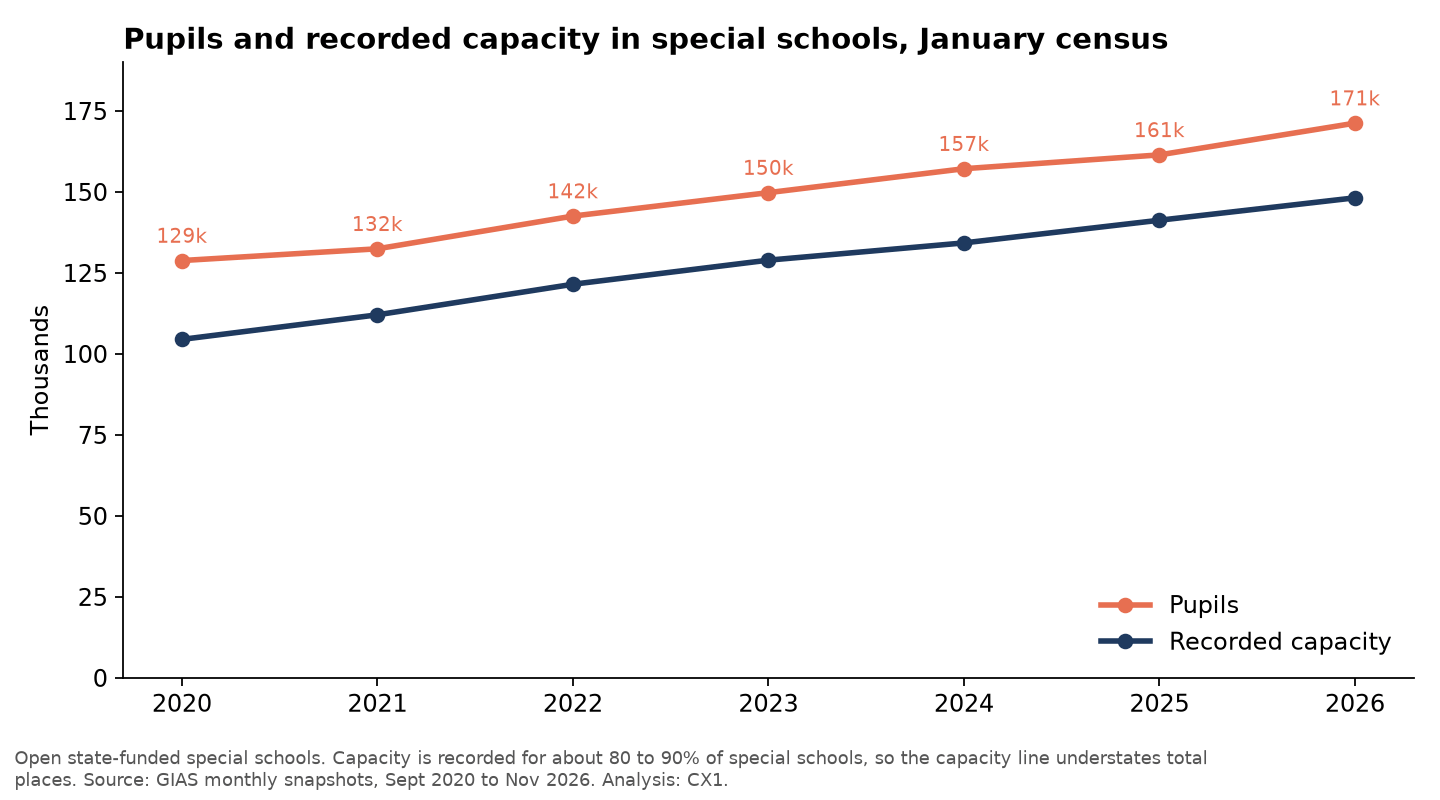
State-funded special schools had 128,747 pupils in January 2020. By January 2026 they had 171,166, an increase of 32.9%. Over the same period mainstream primary rolls fell, so special schools now teach 2.07% of all pupils in state-funded schools, up from 1.55%.
| January census | Open special schools | Pupils | Recorded capacity |
|---|---|---|---|
| 2020 | 1,005 | 128,747 | 104,409 |
| 2022 | 1,032 | 142,477 | 121,429 |
| 2024 | 1,059 | 157,094 | 134,194 |
| 2026 | 1,073 | 171,166 | 148,111 |
State-funded special schools open at each census. Capacity is recorded for only part of the sector (see methodology), so totals are not directly comparable with pupils.
Most of the growth has come from existing schools getting bigger rather than from new schools. At the 872 special schools open with census data in both 2020 and 2026, pupil numbers rose 29.8%. The average special school grew from 128 to 162 pupils and the median from 115 to 144.5.
New schools have helped. 109 new special schools opened between September 2020 and November 2026, most of them special free schools. But the number of open special schools rose by only 68 between the 2020 and 2026 censuses, as some schools closed or merged.
More schools over capacity every year
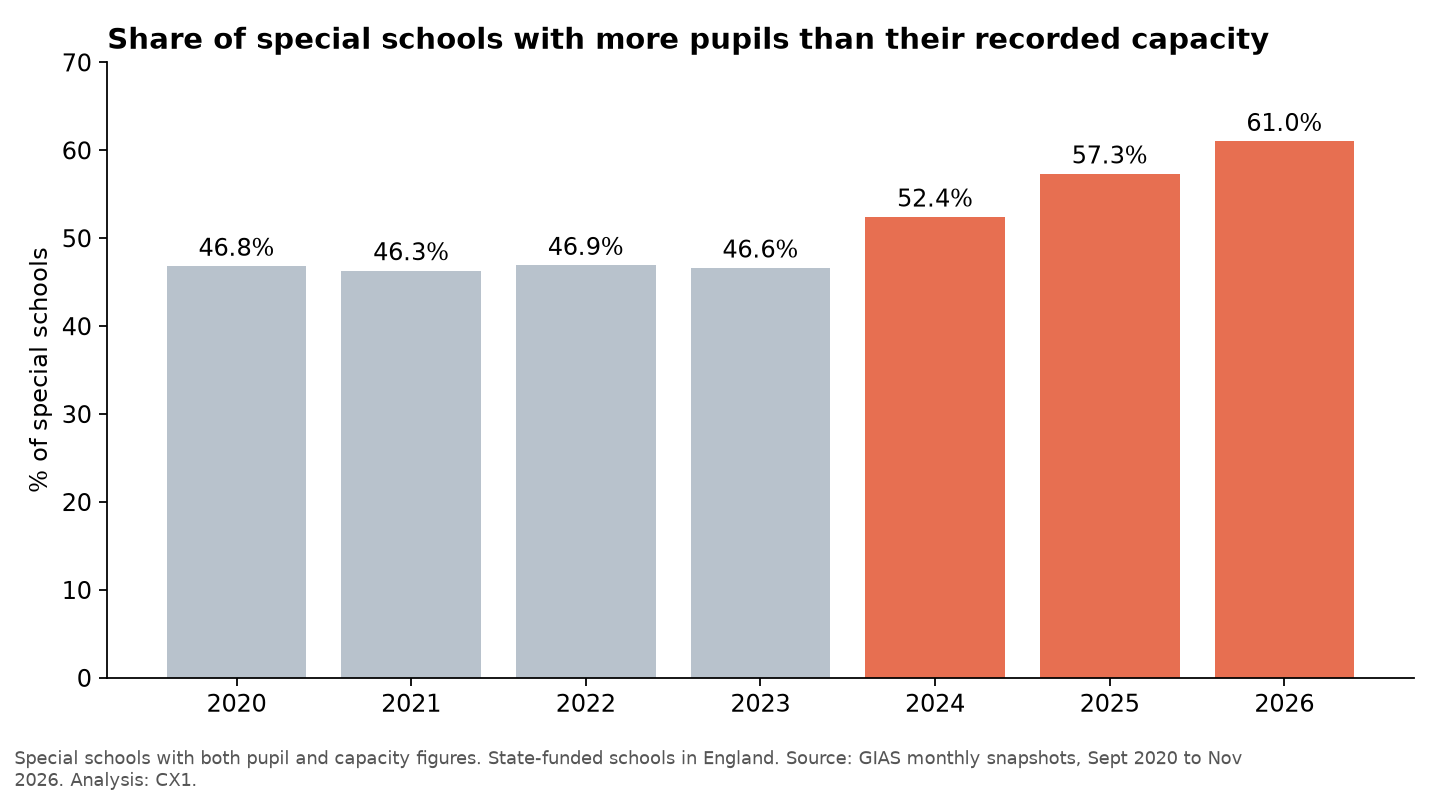
Among special schools that record both figures, the share holding more pupils than their recorded capacity was steady at around 46% to 47% from 2020 to 2023. Then it climbed: 52.4% in 2024, 57.3% in 2025 and 61.0% in 2026. In 2026, 28.8% of these schools were at least 10% over capacity.
Taken together, these schools held 1,672 fewer pupils than their recorded capacity in 2020. By 2026 they held 8,178 more.
Recorded capacity has risen too. At the same 872 schools, it went up 33.3% between 2020 and 2026, which suggests many schools have expanded or updated their figures. Yet the share over capacity still rose, because growth has been concentrated in schools that were already full.
Every region, but the north most of all
| Region | Pupil growth, 2020 to 2026 | Schools over capacity, 2026 |
|---|---|---|
| North West | 44.0% | 69.1% |
| North East | 36.2% | 54.7% |
| Yorkshire and the Humber | 35.8% | 70.4% |
| East of England | 35.7% | 55.5% |
| South West | 33.7% | 61.1% |
| South East | 31.0% | 59.9% |
| London | 30.5% | 55.0% |
| East Midlands | 26.2% | 60.3% |
| West Midlands | 23.8% | 62.6% |
Every region saw special school rolls rise by at least a fifth. The North West grew fastest, adding more than 8,000 pupils, and seven in ten special schools in Yorkshire and the Humber and the North West were over their recorded capacity in 2026.
The independent sector has doubled
The state-funded sector is only part of the story. Independent special schools, often used by councils when no state-funded place is available, have grown even faster. There were 565 open in January 2020 and 952 in January 2026. Their recorded pupils rose from 18,306 to 37,375, more than doubling, even though 70 of those schools had no census figure in 2026. Non-maintained special schools grew more modestly, from 3,775 to 4,552 pupils.
GIAS does not show who pays for these places. But independent places usually cost more than state-funded ones, so growth on this scale is likely to add to the pressure on council high needs budgets.
What this means for pupils, staff and boards
For pupils, an over-full special school can mean larger classes, shared spaces turned into classrooms and less room for therapy, sensory and outdoor provision. Some children wait longer for a place, stay longer in a mainstream setting that cannot meet their needs or travel further to a school that can. Pupils in special schools often depend most on familiar adults and calm, predictable routines, so pressure on space and staffing is felt directly.
For staff, more pupils with complex needs in the same buildings increases workload and the risk of injury and burnout.
For boards, operating above capacity raises questions about safety, accessibility and the quality of provision, as well as about funding agreements with councils. Questions worth asking:
- What is our current roll against our recorded capacity, and is the capacity figure in GIAS up to date?
- Do our fire, evacuation and health and safety plans reflect the number of pupils we actually have?
- How many places are we being asked to take next year, and on what terms?
- Are staff ratios and training keeping pace with the needs of the pupils we admit?
- For mainstream boards: how many of our pupils are waiting for a specialist place, and what support are we giving them in the meantime?
The national picture is one of steadily rising need. The schools at the sharp end of it deserve clear plans and realistic funding, not just more pupils.
Methodology and limitations
We rebuilt pupil numbers and capacity for each January census from 2020 to 2026 using the GIAS change log (76 monthly snapshots, 15 September 2020 to 26 November 2026). State-funded special schools include community and foundation special schools, special academies and special free schools. Independent and non-maintained special schools are reported separately.
GIAS capacity is self-reported and missing for some special schools: 955 of 1,058 special schools with 2026 census figures also had a capacity figure. Over-capacity rates use only schools with both. Census coverage was incomplete in some years (96.6% of open special schools had figures in 2025 and 98.6% in 2026), so totals for those years are slightly understated. These figures do not include specialist places in resourced provision or units within mainstream schools, or pupils with special educational needs in mainstream classes. New schools are those GIAS records as new provision or free schools opened in the period.