
Which schools close? Inner London primaries and England's smallest village schools
What six years of GIAS records show about school closures, and the two very different stories behind them
Most schools that "close" in the official record do not really close at all. Between 15 September 2020 and 26 November 2026, Get Information about Schools (GIAS) recorded 3,132 closures of state-funded schools in England. Of these, 2,640 were academy conversions and 150 were fresh starts, where a school reopens under a new record. Only 324 were real closures: 156 schools that closed outright and 168 that closed as part of an amalgamation or merger.
Real closures are rare, about one school in every 70 over six years. But they have risen every year since 2021/22, and they are concentrated in two very different kinds of place.
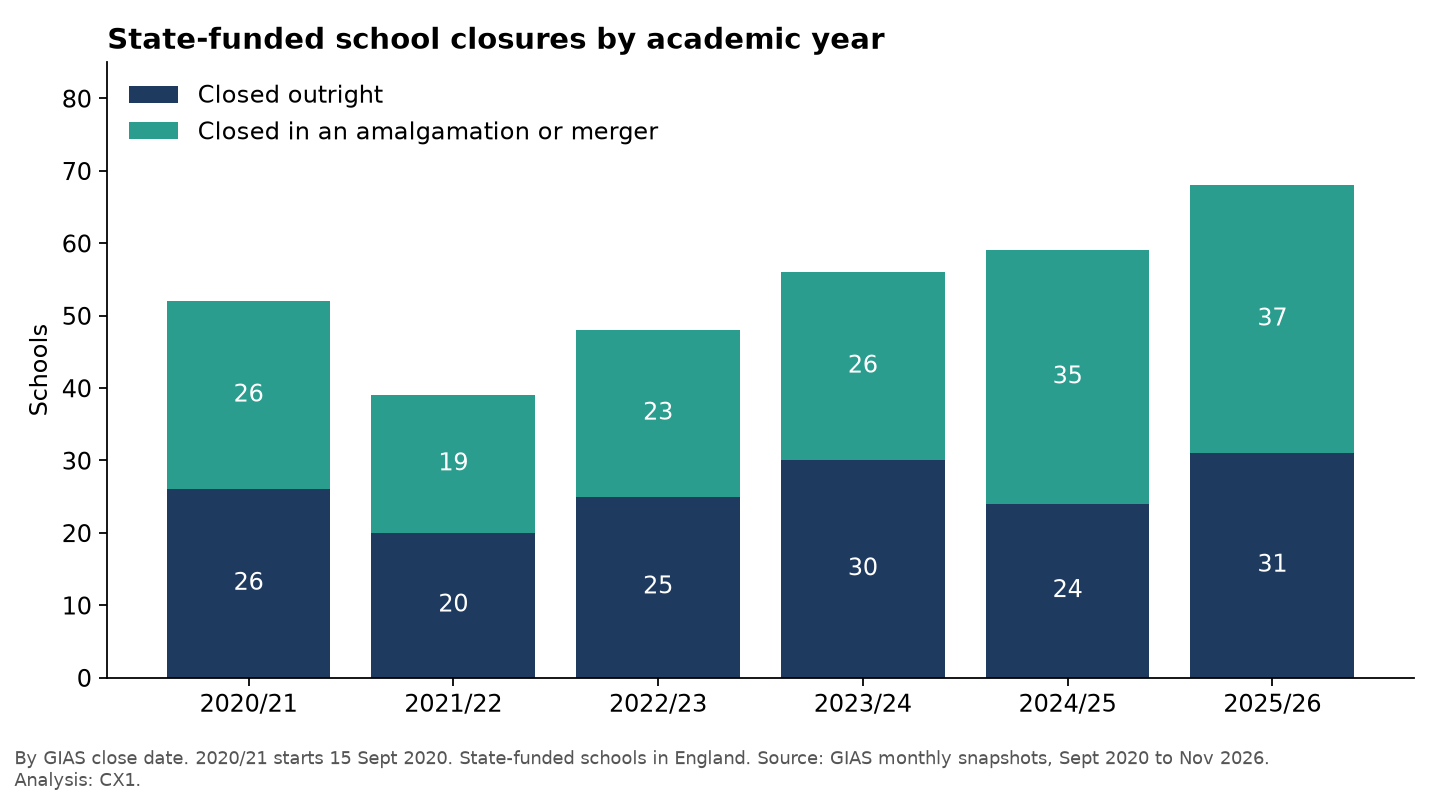
Closures are rising
| Academic year | Closed outright | Amalgamation or merger | Total |
|---|---|---|---|
| 2020/21 | 26 | 26 | 52 |
| 2021/22 | 20 | 19 | 39 |
| 2022/23 | 25 | 23 | 48 |
| 2023/24 | 30 | 26 | 56 |
| 2024/25 | 24 | 35 | 59 |
| 2025/26 | 31 | 37 | 68 |
2020/21 runs from 15 September 2020. State-funded schools in England, by GIAS close date.
2025/26 had the most closures of any year in the period, at 68. Amalgamations have grown fastest, from 19 in 2021/22 to 37 in 2025/26.
Primary schools account for most closures: 240 of the 324. There were also 30 secondary schools, 25 pupil referral units or alternative provision settings, 15 nursery schools and 11 special schools. Across England the number of open primaries fell by 123 between September 2020 and November 2026, while the number of special schools rose by 70.
Story one: inner London
| Area type | Primary closures | Per 100 primaries open in 2020 | Median pupils at last census |
|---|---|---|---|
| Inner London | 50 | 7.1 | 154 (outright) |
| Outer London | 23 | 2.1 | 152 (outright) |
| Rural village and hamlet | 61 | 2.0 | 24 (outright) |
| Urban areas outside London | 95 | 0.9 | 93 (outright) |
| Rural town and fringe | 11 | 0.6 | 26 (outright) |
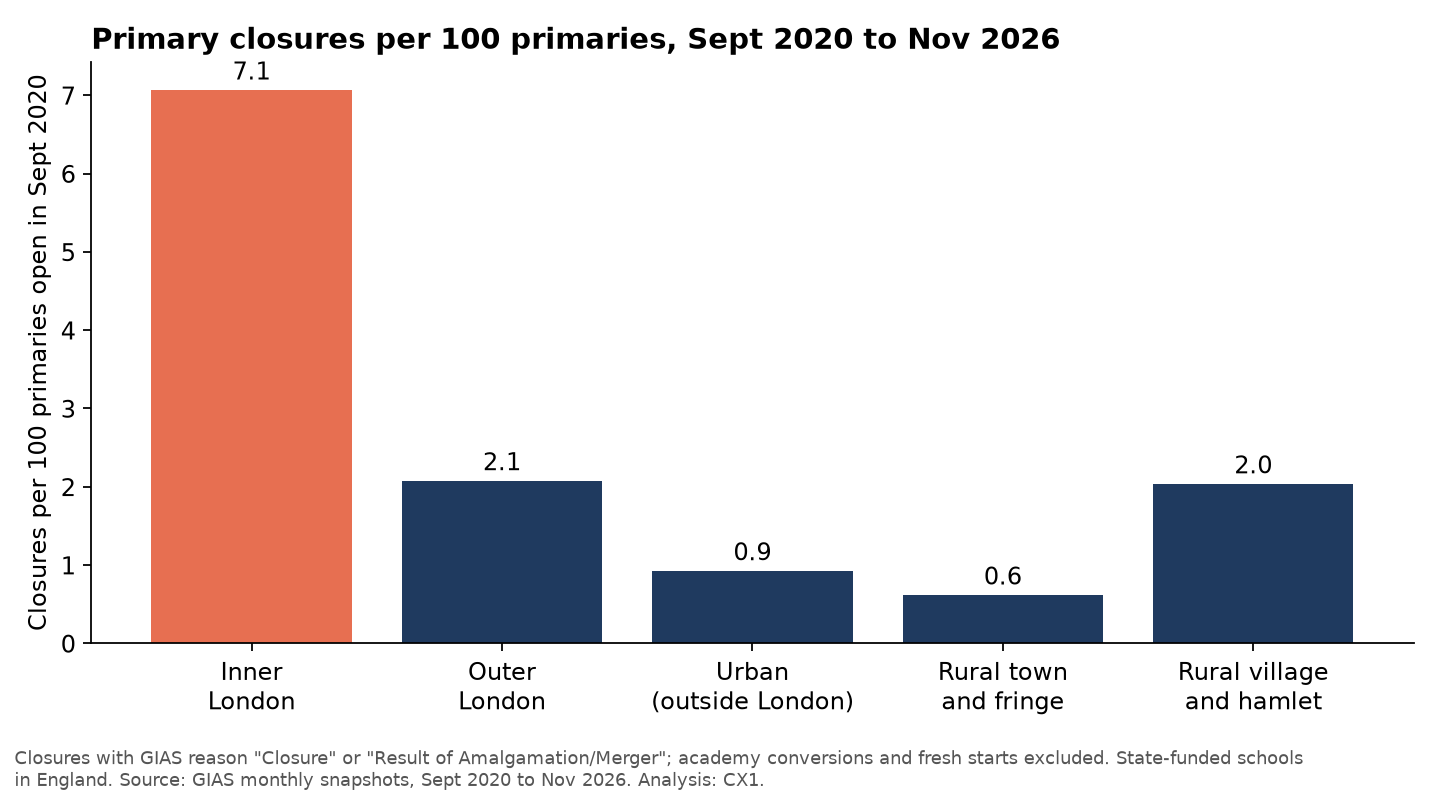
Inner London lost 50 of the 707 primaries it had in September 2020, a rate of 7.1 per 100. That is more than seven times the rate for urban primaries outside London (0.9). The highest rates among councils with at least 40 primaries were Islington (7 of 46 primaries), Hackney (8 of 58), Brighton and Hove (6 of 52) and Southwark (8 of 74).
These were not tiny schools. The inner London primaries that closed outright had a median of 154 pupils at their last census, a size that would be viable in many parts of the country. They closed against a background of sharply falling rolls: inner London primary rolls fell 10.5% at the same schools between 2020 and 2026. London closed 22 primaries in 2024/25 alone.
Story two: the smallest village schools
The second story is rural. Rural villages and hamlets lost 61 primaries, a rate of 2.0 per 100, more than twice the urban rate outside London. Here the schools that closed outright were very small, with a median of just 24 pupils at their last census.
North Yorkshire closed 16 primaries, more than any other council. Thirteen closed outright and 11 of those had fewer than 30 pupils. Twelve of the 16 were Church of England schools. Across England, the 111 primaries that closed outright had a median of 64 pupils and were typically less than half full (a median of 47.7% of recorded capacity). Of those 111, 49 had fewer than 50 pupils.
For a small community the village school can be one of its last shared services. Its closure can mean young children travelling much further each day.
Infant and junior schools are merging
Amalgamations tell a third, quieter story. Of the 129 primaries that closed in an amalgamation or merger, 53 were infant schools and 29 were junior schools. Many are likely to have joined with their partner school to form a single primary, which can secure leadership and finances for both. Pupils usually stay on the same site, but the change can still be significant for families and staff.
What this means for pupils, staff and boards
For pupils, a closure means moving school, often part-way through primary and sometimes with little warning. Pupils with special educational needs and those who rely on the school for stability can find this hardest. In rural areas the next school may be some distance away.
For staff, closure brings redundancy or redeployment. In amalgamations, staff may need to reapply for posts in the new structure.
For boards, the warning signs usually appear years before a closure decision. Falling rolls, a growing share of empty places and a shrinking budget are all visible in the data long before the formal process starts. Questions worth asking:
- How has our roll changed over the last five years and what do the next three Reception intakes look like?
- At what point would our school stop being financially viable on its own?
- Have we explored federation, partnership or amalgamation with neighbouring schools while we still have choices?
- If closure or amalgamation is proposed, how will we support pupils with the move, especially vulnerable pupils and those with special educational needs?
- Who would hold safeguarding records, pupil files and other data once the school closes, and is that plan written down?
Closure is rarely sudden. The schools and communities that come through it best are the ones that saw it coming and planned together.
Methodology and limitations
Closures are state-funded schools in England with a GIAS close date between 15 September 2020 and 26 November 2026 and a close reason of "Closure" or "Result of Amalgamation/Merger". Academy conversions, fresh starts and changes of status are excluded because the school continues under a new record. Pupil numbers at last census come from the GIAS change log (76 monthly snapshots), using the last January census figure before closure. Rates per 100 use primaries open on 15 September 2020 as the base. Infant and junior schools are identified from their statutory age ranges.
GIAS records the reason a school closed in broad categories and does not show the full background to each decision. Some closures recorded as outright closures may have involved pupils transferring to a nearby school. Closures dated after 26 November 2026 are not included.