
230 new schools since 2020, and a third of them are special schools
What the GIAS record shows about where England's newest schools are opening and how quickly they fill
Most of the change in England's school system since 2020 has been about existing schools changing hands: converting to academies, moving between trusts or merging. Brand-new schools are a much smaller part of the story, but they show where the system has decided it needs extra places.
We looked at every state-funded school in England that opened as new provision between 15 September 2020 and 26 November 2026, using monthly snapshots of Get Information about Schools (GIAS). We left out academy conversions, sponsored academies and fresh starts, which reopen an existing school under a new record. That leaves 230 genuinely new schools. 226 are still open; 4 have since closed.
A third are special schools
| Phase | New schools | Share |
|---|---|---|
| Primary | 83 | 36% |
| Special | 78 | 34% |
| Secondary | 42 | 18% |
| 16 plus | 10 | 4% |
| All-through | 10 | 4% |
| Alternative provision | 7 | 3% |
| Total | 230 |
Almost all of the new schools are free schools: 134 mainstream free schools, 78 special free schools, 9 16 to 19 free schools and 7 alternative provision free schools, plus one secure 16 to 19 academy and one university technical college.
The 78 special schools stand out. Special schools are about 5% of the state-funded schools open in England, yet they make up a third of the new ones. That fits our earlier analysis showing special school pupil numbers up by a third since 2020 and six in ten special schools holding more pupils than their recorded capacity.
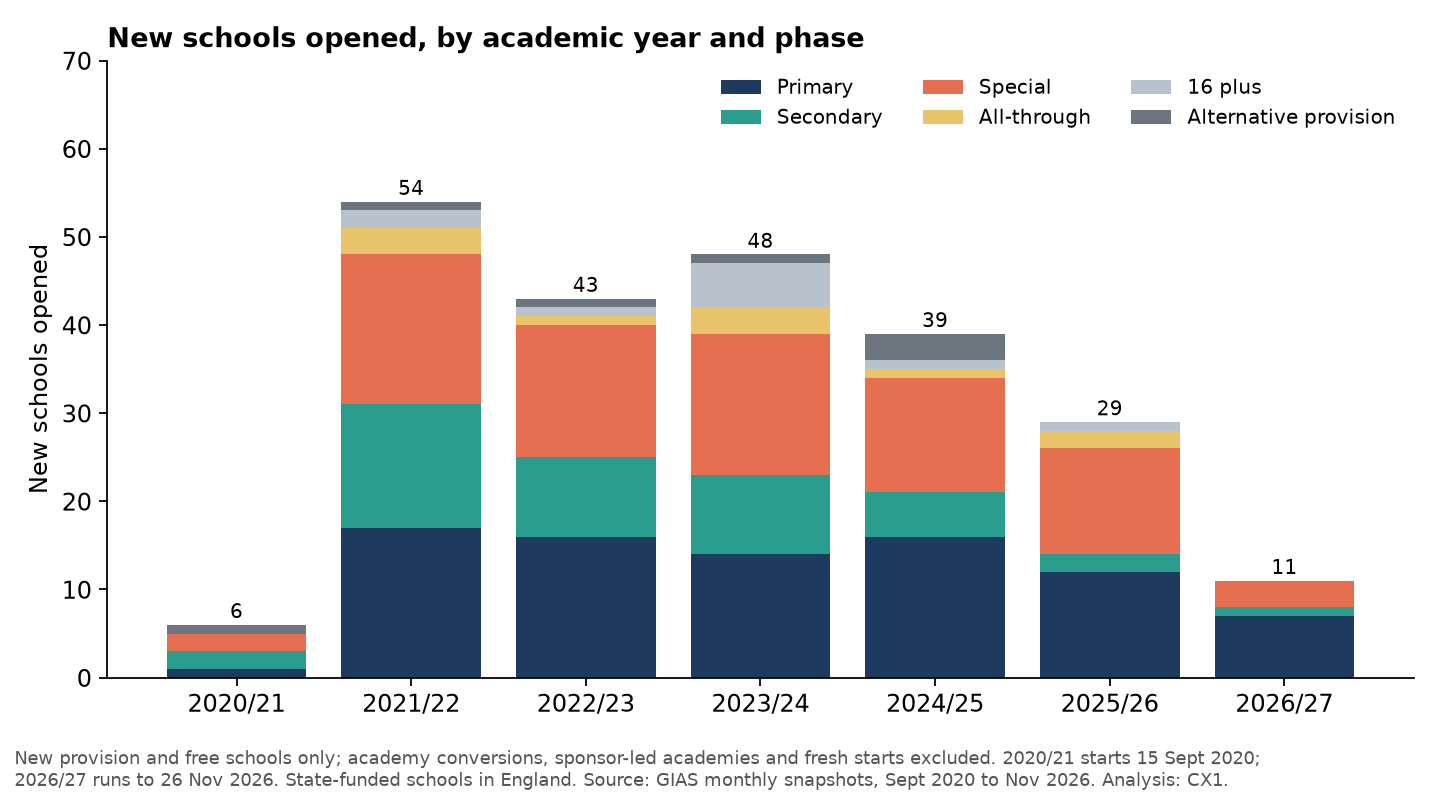
Openings peaked at 54 in 2021/22 and have slowed since: 43, 48, 39 and then 29 in 2025/26. A further 11 had opened in the first three months of 2026/27. Special school openings have been the steadiest part of the pipeline, at between 12 and 17 a year since 2021/22. Secondary openings have fallen from 14 in 2021/22 to 2 in 2025/26.
Where they are
The West Midlands opened the most new schools (38), followed by the South East and East of England (36 each). The North East opened 5. London opened 28, but only 5 were mainstream primaries and 14 were special schools. Most new schools (175) are in urban areas outside London. Only 6 are in inner London, where primary rolls have fallen fastest.
How quickly new schools fill
New mainstream schools often open with a single year group and add one each year, so a new primary can take seven years to fill. Low fill in the early years is expected. With that in mind, we looked at schools that had been open for at least two full years, opening between September 2020 and September 2023, and compared their January 2026 pupil numbers with their recorded capacity.
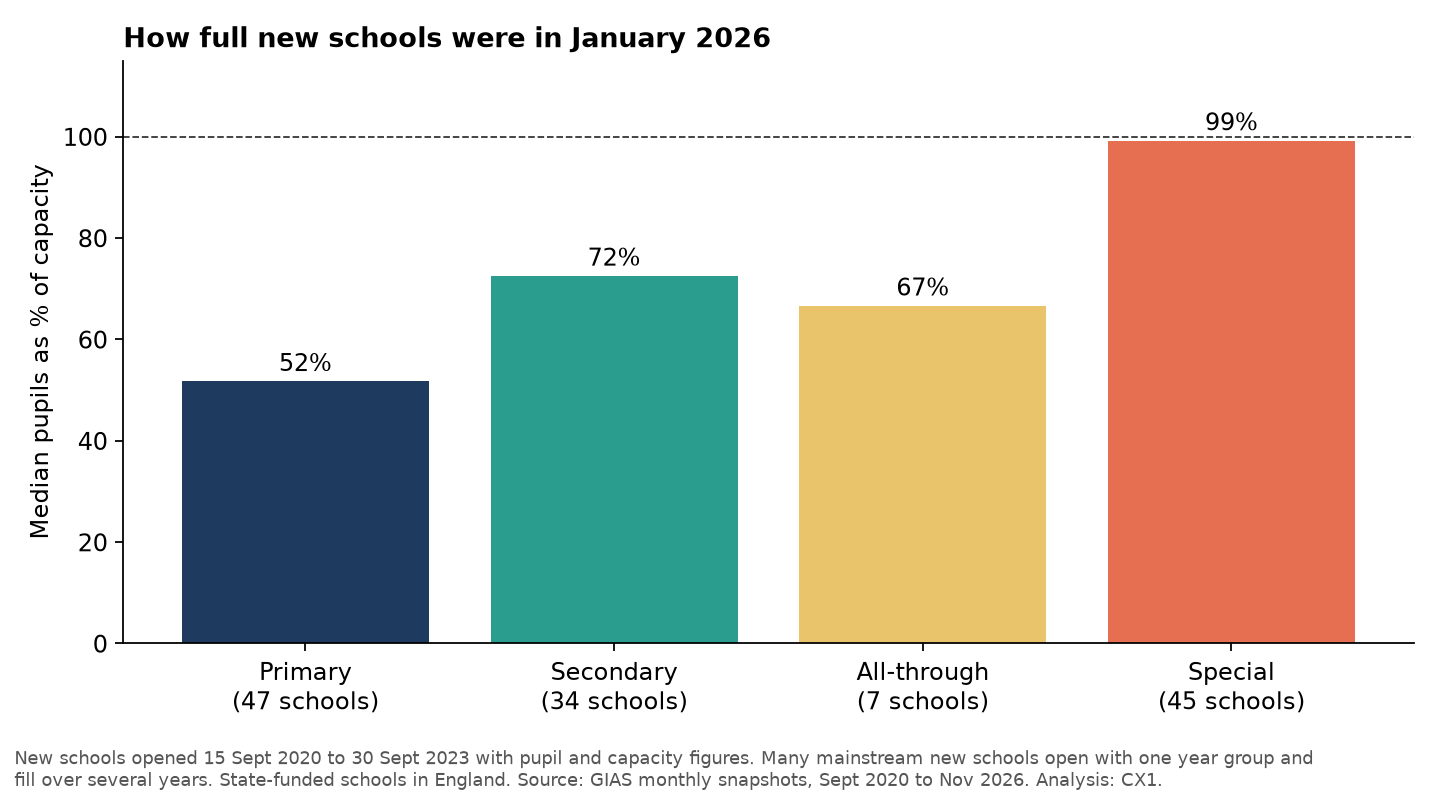
The difference between phases is striking. The 45 special schools in this group had a median fill of 99.2%, and 18 of them already had more pupils than their recorded capacity. The 34 secondaries had a median fill of 72.5%. The 47 primaries had a median of 51.7%, and 20 of them were less than half full.
Across all 83 new primaries, there were 10,530 pupils on roll against 29,523 recorded places. For the 42 new secondaries the figures were 25,516 pupils and 41,820 places. Some of that gap is schools still growing year by year, and the most recent openings will be close to empty by design.
New primaries where rolls are falling
The primary picture raises a harder question. Of the 83 new primaries, 62 are in council areas where pupil numbers at existing primaries fell between 2020 and 2026. 19 are in councils where existing primaries lost 5% or more of their pupils. Only 21 are in councils where existing primary rolls rose.
Council-wide figures can hide a lot. A new primary may serve a new housing estate in one corner of a council area while schools elsewhere empty, and GIAS cannot show where new homes are being built or where families are moving. But it does mean that many new primaries are opening into local markets where neighbouring schools are already losing pupils.
What this means for pupils, staff and boards
For pupils, new special schools are adding places where they are badly needed. The concern is that they fill so quickly. If a special school is at capacity within a few years of opening, it eases pressure briefly rather than solving it, and families may still face long journeys or long waits for a place.
For staff, new schools offer roles and promotion that are otherwise scarce when rolls are falling. But a new primary that opens with a single class needs a small, flexible team that can grow, and a slow-filling school can struggle to fund the specialist roles it planned for.
For boards of neighbouring schools, a new primary or secondary nearby can change the local picture quickly. For trusts opening new schools, the question is whether the forecast that justified the school still holds. Questions worth asking:
- If a new school is opening near us, what does it mean for our admissions over the next five years, and have we discussed it with the local authority?
- For a new school we run, how does actual recruitment compare with the forecast in the original proposal?
- For special schools, how do we manage demand when we are full on opening, and what is the plan for further places?
- If a new primary is filling slowly, at what roll does its staffing and curriculum model become sustainable?
New schools are a long-term bet on where children will be. In special education the places were needed at once. In some primary areas it may take longer to judge.
Methodology and limitations
We used the GIAS change log (76 monthly snapshots, 15 September 2020 to 26 November 2026) and the live GIAS establishment table. A new school is a state-funded school in England with an open date in that period and a GIAS opening reason of new provision, free school or free special school. Sponsor-led academies, academy converters and fresh starts are excluded because they replace an existing school. Phase, region and council are taken from the current GIAS record. Academic years run from September to August.
Fill compares pupil numbers from the January 2026 census with the capacity each school records in GIAS. Capacity for a new school usually reflects its size when full, not the year groups it currently teaches, so low fill for young mainstream schools is not a sign of failure in itself. Council primary roll changes use the same schools open with census data in both 2020 and 2026. GIAS does not hold data on housing, admissions applications or pupil forecasts, so we cannot say why each school was opened or whether its forecast will be met.