
Federations: the quiet alternative to joining a trust
What GIAS shows about council-maintained schools that share governance and leadership
Most of the debate about school structures is about academies and trusts. Far less attention goes to federations, where two or more council-maintained schools share a single governing board and often a single executive headteacher. Each school keeps its own identity and budget, but leadership and governance are shared.
We looked at federations in Get Information about Schools (GIAS), combining the federation recorded against each open school with the history of federation records in our monthly snapshots from 15 September 2020 to 26 November 2026.
How many schools are federated?
In November 2026, 1,154 open state-funded schools in England were recorded as part of a federation. Between them they make up 488 federations. Most are pairs: 371 federations have two open schools and 107 have three or more.
Almost all are council-maintained mainstream schools. 1,123 of the 9,206 open maintained mainstream schools (12.2%) are federated, plus 31 maintained special schools. No academies are recorded in federations; academies collaborate through trusts instead.
Small schools and two very different places
Federation is most common where schools are small.
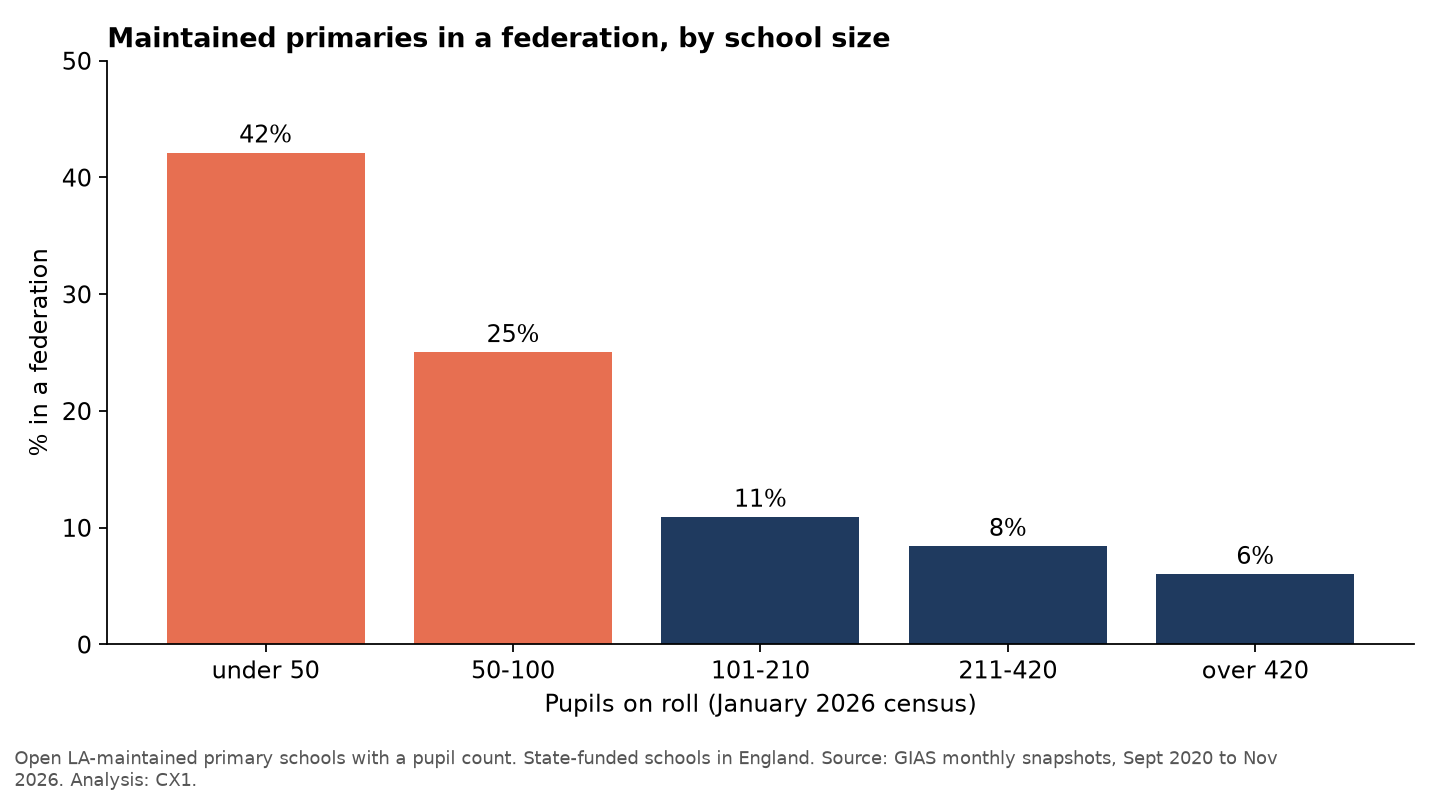
Among council-maintained primaries with fewer than 50 pupils, 42.1% are federated. For those with 50 to 100 pupils it is 25.0%. Above 210 pupils the share drops to 8.4% and then 6.0% for the largest primaries.
Geography follows from that, with one surprise.
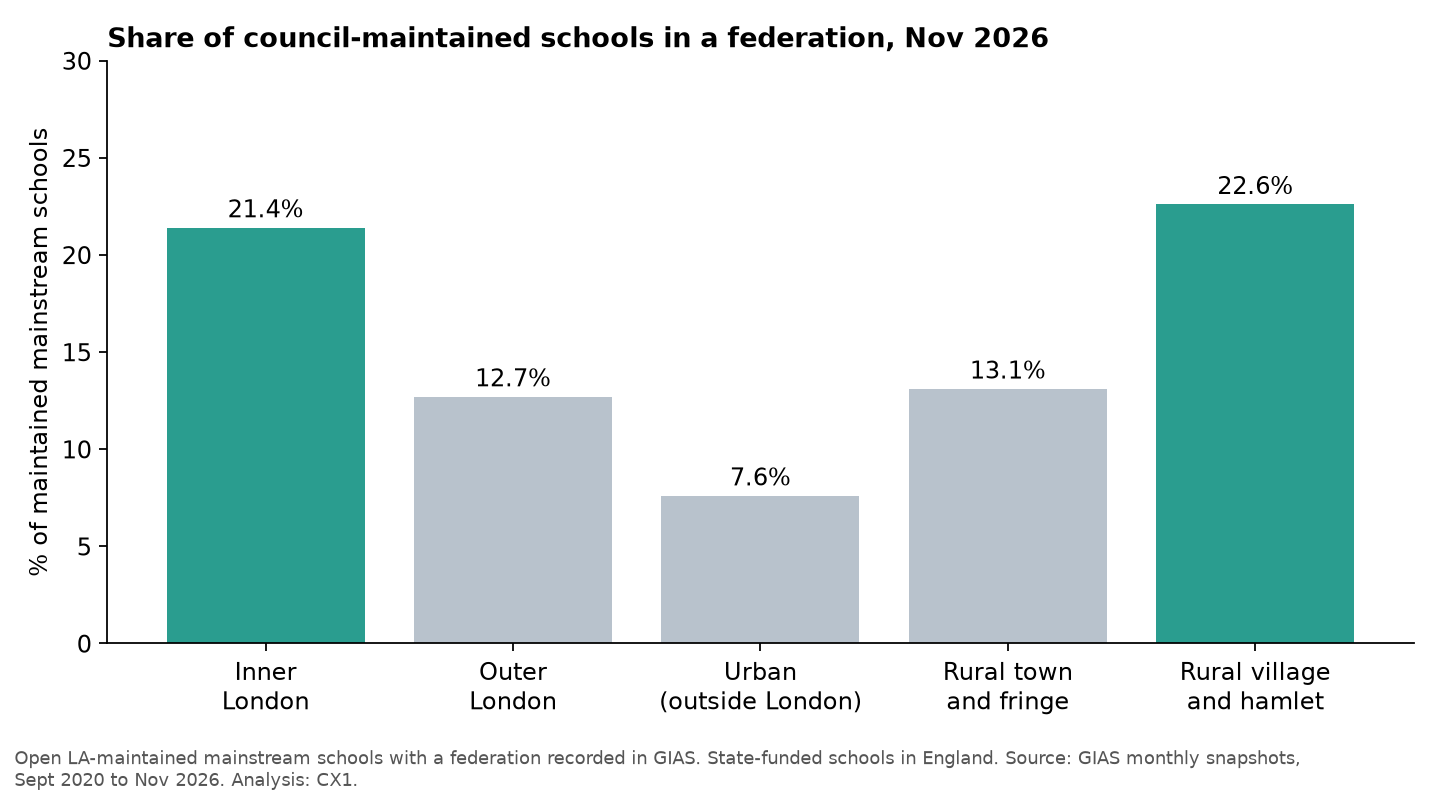
In rural villages and hamlets, 22.6% of maintained schools are federated. In inner London the figure is almost the same at 21.4%. In urban areas outside London it is just 7.6%. Inner London's primaries are not small in the way rural village schools are, though they have seen the steepest fall in primary pupil numbers in the country. The data cannot show whether the two are linked.
| Area | Maintained mainstream schools | In a federation | Share |
|---|---|---|---|
| Rural village and hamlet | 1,696 | 384 | 22.6% |
| Inner London | 585 | 125 | 21.4% |
| Rural town and fringe | 925 | 121 | 13.1% |
| Outer London | 748 | 95 | 12.7% |
| Urban (outside London) | 5,252 | 398 | 7.6% |
The regional picture is uneven. The South West has the highest share (18.7%), followed by London (16.5%) and the South East (15.8%). The North West has just 2.2%, with 39 federated schools out of 1,763 maintained schools. Among councils with at least 40 maintained schools, Devon has half of its maintained schools in federations (58 of 116), followed by Hackney (42.6%), Norfolk (40.1%) and Walsall (38.8%).
Does sharing leadership mean steadier leadership?
One argument for federation is that a shared executive head can provide continuity that a small school struggles to find alone. We tested this against our headteacher analysis, which counted genuine changes of head at every school in the four complete academic years in our data (2021/22, 2022/23, 2024/25 and 2025/26).
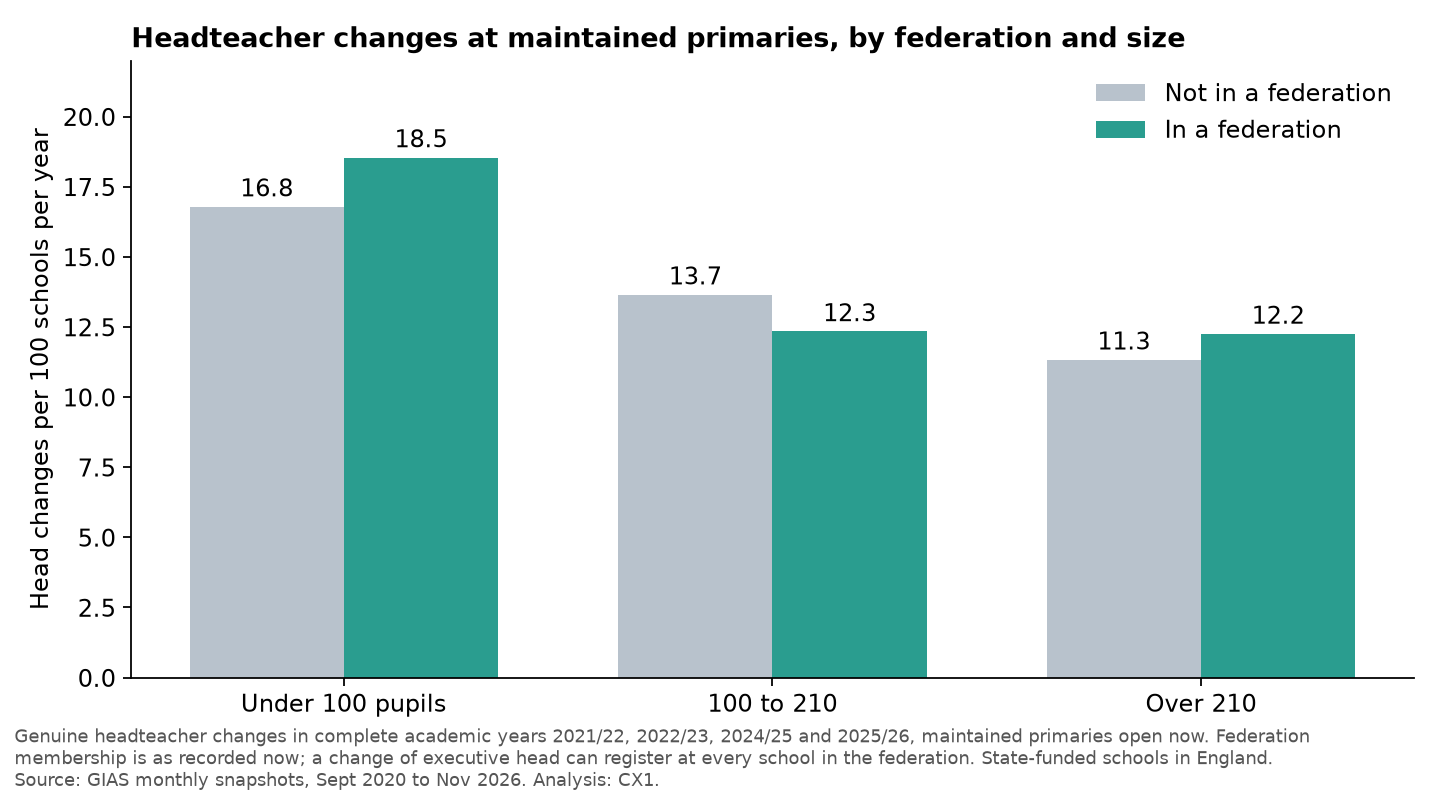
Federated maintained primaries recorded 14.5 head changes per 100 schools per year, against 12.7 for other maintained primaries. That gap is mostly about size, because small schools change heads more often whichever way they are run. Comparing schools of similar size, the picture is mixed. Federated schools with under 100 pupils changed head slightly more often (18.5 against 16.8). Those with 100 to 210 pupils changed less often (12.3 against 13.7). Larger federated schools changed slightly more often (12.2 against 11.3).
So the data does not show that federation leads to more stable headship. It does not show the reverse either. When an executive head leaves a federation, the change is recorded at every school in it, so federated schools can look less stable than they are.
A record that needs tidying
There were 745 federations with an open status in GIAS in November 2026, but only 488 had any open school recorded against them. The other 257 appear to be federations whose schools have left, closed or converted, while the federation record itself was never closed. By their recorded dates, 188 federations opened and 101 closed between September 2020 and November 2026, but because closures are not always recorded, those figures are a weak guide to whether federation is growing.
What this means for pupils, staff and boards
For pupils, federation can help a small school stay open. Sharing leaders, specialist staff and resources across schools can protect a village or local school that would struggle alone. The concern is that pupils in a federation can lose the visible day-to-day presence of a head who is based in their school.
For staff, federations can offer career routes and shared expertise that a single small school cannot. They can also stretch leaders across sites. Heads of school and senior teachers often carry more responsibility without the title or pay of a headteacher.
For boards, a federated governing board oversees several schools with different needs. Many federations are also weighing whether to join or form a trust. Questions worth asking:
- Do we know how much time our executive head spends at each school, and is that enough?
- Are our heads of school and middle leaders supported and paid for the responsibility they carry?
- If our executive head left, how would we keep both schools stable?
- Is our GIAS record accurate, and does it show the schools we actually govern?
Federations are a small part of the system, but for hundreds of small schools they are the main way of sharing leadership. They deserve more attention than they get.
Methodology and limitations
Current federation membership comes from the federation code recorded against each open state-funded school in England in the live GIAS establishment table on 26 November 2026. GIAS does not keep a history of which schools were in each federation, so we cannot show how membership has changed over time. Federation records and their open and close dates come from the GIAS groups table and our change log (76 monthly snapshots, 15 September 2020 to 26 November 2026). Area type uses the GIAS urban and rural classification; inner London uses the ONS definition. Size bands use January 2026 census pupil numbers.
Head change rates use the method from our earlier headteacher analysis: genuine changes of named head in the complete academic years 2021/22, 2022/23, 2024/25 and 2025/26, excluding spelling and title corrections, for maintained primaries open now, divided by school-years observed. Federation status is current, so a school that joined a federation recently is treated as federated for the whole period. The comparison shows association only; it cannot show whether federation affects leadership turnover.