
Fewer, bigger trusts: how England's academy landscape has consolidated since 2020
Six years of GIAS records show small trusts merging into larger ones and over a thousand academy moves between trusts
More schools are academies than ever, but they are being run by fewer organisations. Using monthly snapshots of Get Information about Schools (GIAS), we rebuilt the membership of every multi-academy trust (MAT) in England from September 2020 to November 2026. The trend is clear: consolidation.
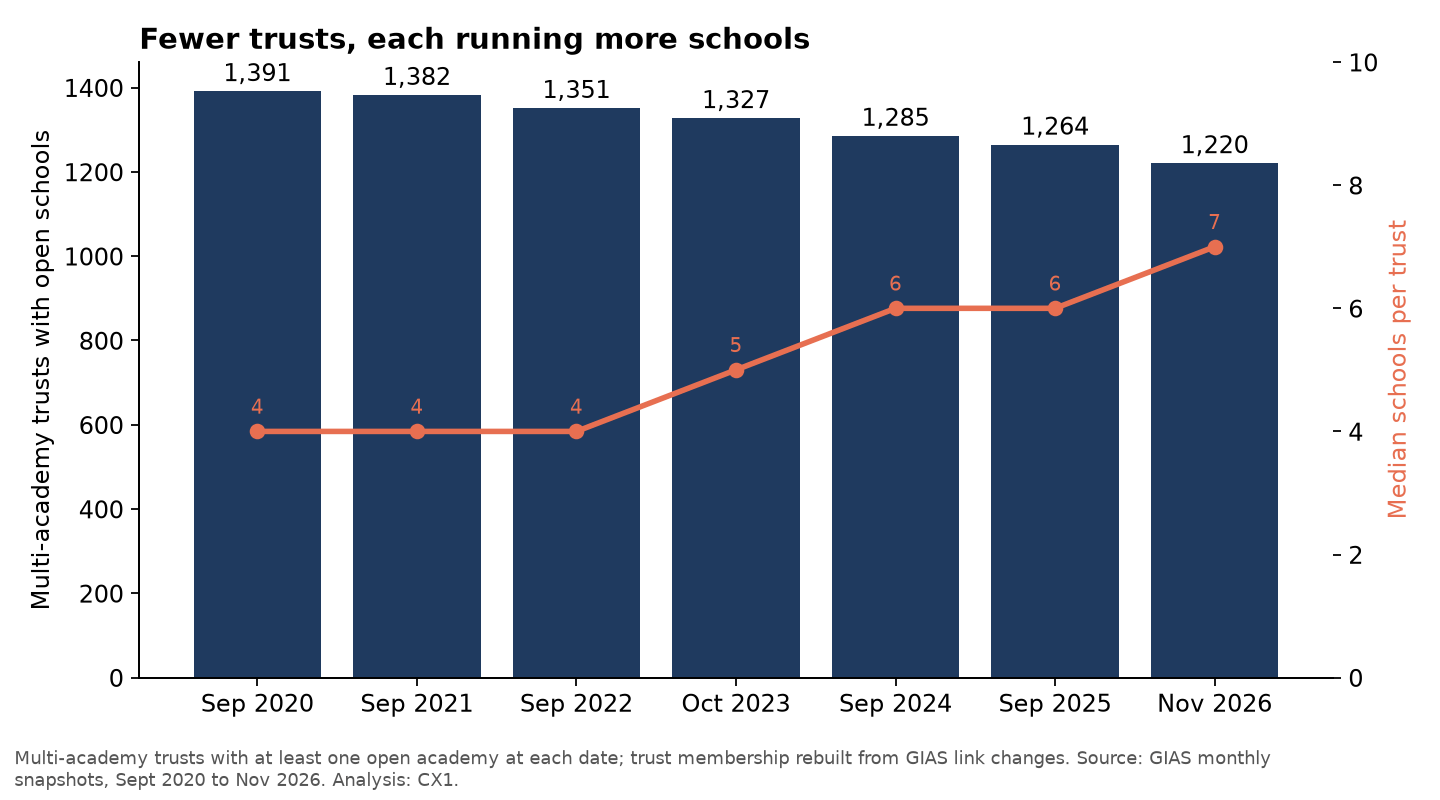
Fewer trusts, each running more schools
In September 2020, 1,391 MATs ran 8,055 open academies between them. By November 2026, 1,220 MATs ran 11,310. That is 171 fewer trusts (down 12.3%) running 3,255 more schools.
| Measure | Sept 2020 | Nov 2026 |
|---|---|---|
| Multi-academy trusts with open schools | 1,391 | 1,220 |
| Academies in MATs | 8,055 | 11,310 |
| Academies in single-academy trusts | 1,246 | 796 |
| Median schools per MAT | 4 | 7 |
| MATs with 26 or more schools | 32 | 71 |
| MAT academies in trusts of 11 or more schools | 42.2% | 63.7% |
| MAT academies in trusts of five or fewer | 31.8% | 12.8% |
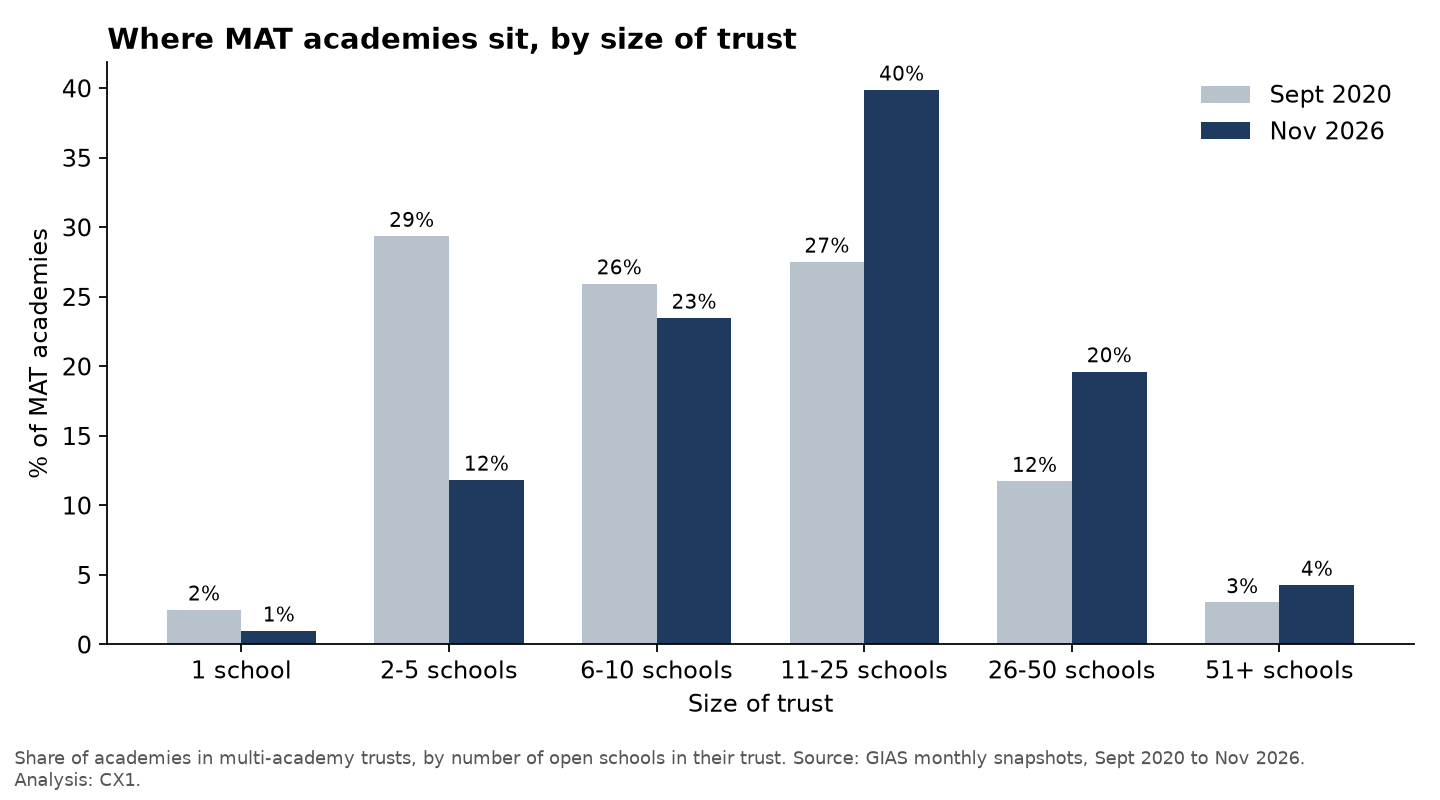
The median trust has grown from four schools to seven. Almost two thirds of MAT academies are now in a trust of 11 or more schools, up from 42.2%. Single-academy trusts are disappearing steadily: they ran 1,246 academies in 2020 and 796 in 2026.
The middle is growing, not just the giants
It would be easy to assume that a handful of very large trusts are taking over. The data does not show that. The 20 largest trusts ran 10.5% of MAT academies in 2020 and 9.2% in 2026. Only seven trusts run more than 50 schools, up from four.
The real growth is in the middle. Trusts of 11 to 25 schools ran 27% of MAT academies in 2020 and 40% in 2026. Trusts of 26 to 50 schools went from 12% to 20%. Trusts of two to five schools fell from 29% to 12%.
The largest trust, United Learning, grew from 73 to 110 open schools. But four of the five fastest-growing trusts since 2020 are Catholic diocesan trusts: St Gabriel the Archangel Catholic Multi-Academy Trust (15 to 64 schools), Emmaus Catholic Academy Trust (1 to 39), Bishop Wilkinson Catholic Education Trust (13 to 46) and Bishop Bewick Catholic Education Trust (6 to 39). This matches the rapid academisation of Catholic primaries over the same period.
Over a thousand moves between trusts
Consolidation happens partly through trust mergers and transfers. Between September 2020 and November 2026, GIAS recorded:
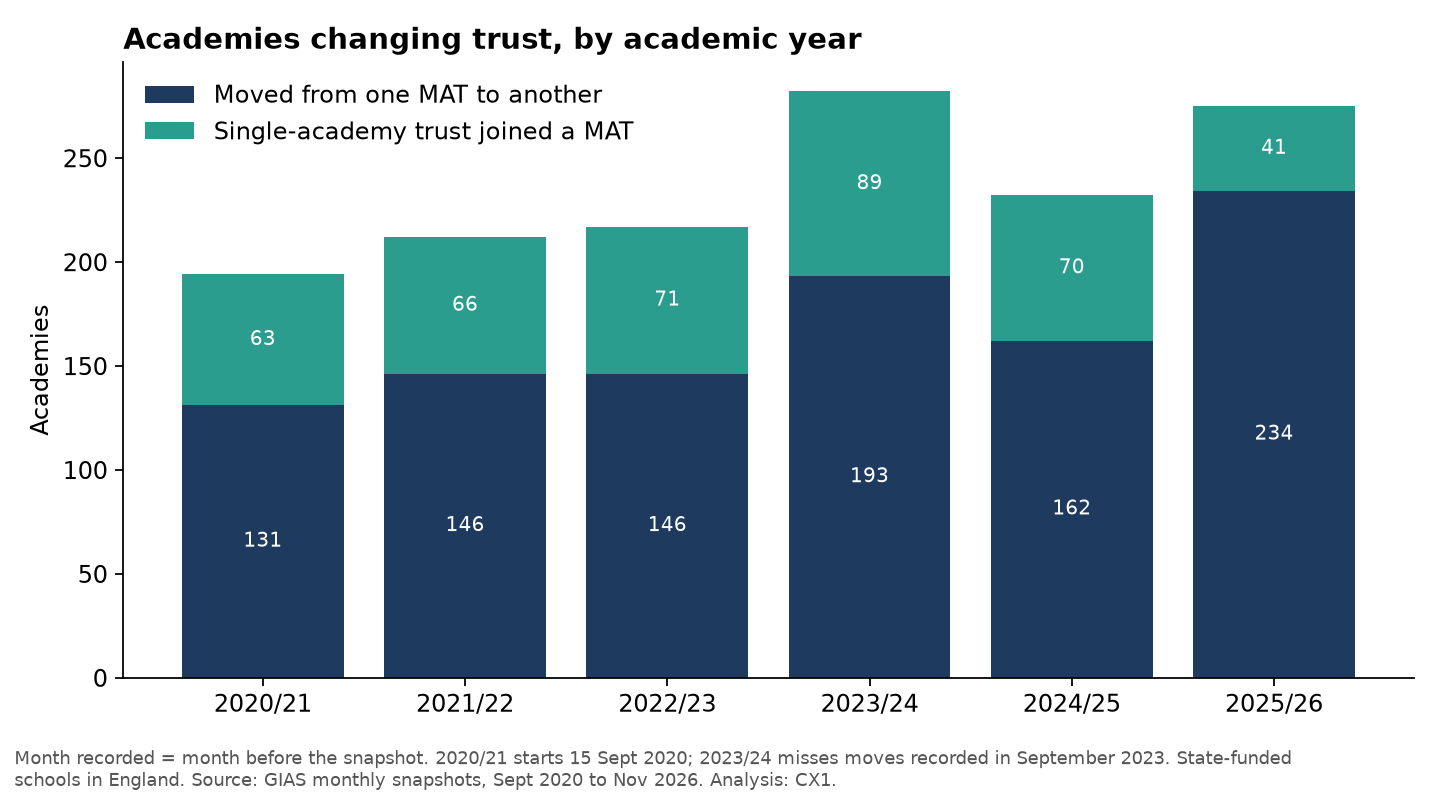
- 1,061 moves of an academy from one MAT to another
- 407 single-academy trusts joining a MAT
Of the 1,061 MAT-to-MAT moves, 654 came from a trust that closed during the period. They came from 307 different trusts in total. Most transfers are therefore whole trusts merging into others rather than individual schools being moved, although GIAS cannot always tell the two apart. Over the same period 329 MATs and 536 single-academy trusts closed.
Transfers have grown. MAT-to-MAT moves rose from 131 in 2020/21 to 234 in 2025/26. Most involved primaries (779), followed by secondaries (196) and special schools (58). The South West recorded the most (237), followed by the East of England (148).
What this means for pupils, staff and boards
Larger trusts can offer real advantages: shared expertise, stronger central teams, better purchasing and more career routes for staff. Small trusts can find it hard to fund a central team or recruit trustees, and merging can secure their schools' future. But scale brings its own risks.
For pupils, a change of trust can mean a new curriculum, new behaviour policy and sometimes a new head. Our headteacher analysis found that 35.8% of academies that moved trust recorded a head change within a year either side of the move, against 31.1% of academies that stayed put over a comparable window. For most pupils the change is invisible. For some it is a real disruption.
For staff, a transfer means a new employer, new policies and sometimes new expectations about moving between schools. Clear communication and continuity of local leadership matter.
For boards, consolidation changes where decisions are made. In a trust of 25 schools, local governing bodies may have less say than they did in a trust of four. Trustees are responsible for more schools, more pupils and more risk, often spread across a wider area. Questions worth asking:
- As our trust grows, how do trustees keep a clear, current view of risk in every school, not just the ones causing concern?
- What do local governors decide and what do they only advise on? Is that written down and understood?
- If we are a small trust, have we tested our long-term sustainability honestly, and would a planned merger be better than waiting?
- When schools join us, what due diligence do we do on safeguarding, finance, estates and data protection, and how quickly do we bring their records into our systems?
- If we are joining a larger trust, what will stay the same for our pupils and what will change in the first year?
The direction of travel is clear. The question for every board is whether governance and risk management are growing as fast as the trusts themselves.
At CX1 and EduRisk we see this most often when schools join a trust and their risk registers, policies and evidence arrive in different formats. Getting them into one place early makes the first year far easier.
Methodology and limitations
We rebuilt each academy's trust from the GIAS change log (76 monthly snapshots, 15 September 2020 to 26 November 2026), working back from current GIAS trust links. Trust size counts open state-funded academies and free schools in England at each date. Trust type (MAT or single-academy trust) is each group's current GIAS type. Trust closures use the closed date in GIAS group records. Moves between trusts are changes of trust ID where both the old and new trust are recorded, counted by the month the change appeared.
Our change log did not compare September and October 2023 directly, so trust moves recorded in September 2023 are missing from the 2023/24 figure, and trust membership in October 2023 is used in place of September 2023. A trust that changes name keeps its GIAS ID, so renaming is not counted as a move. GIAS does not record why a school moved trust.