
Half of primaries are now academies, but conversions fell by 40% last year
What the GIAS record shows about academisation since 2020 and where it is heading
In September 2020, 42.3% of state-funded schools in England were academies or free schools. By September 2026 the figure was 55.0%. Academies now teach 65.0% of pupils in state-funded schools, up from 54.1% in 2020. We used Get Information about Schools (GIAS) to track every conversion and every open school, month by month, to see how England's school system has changed shape.
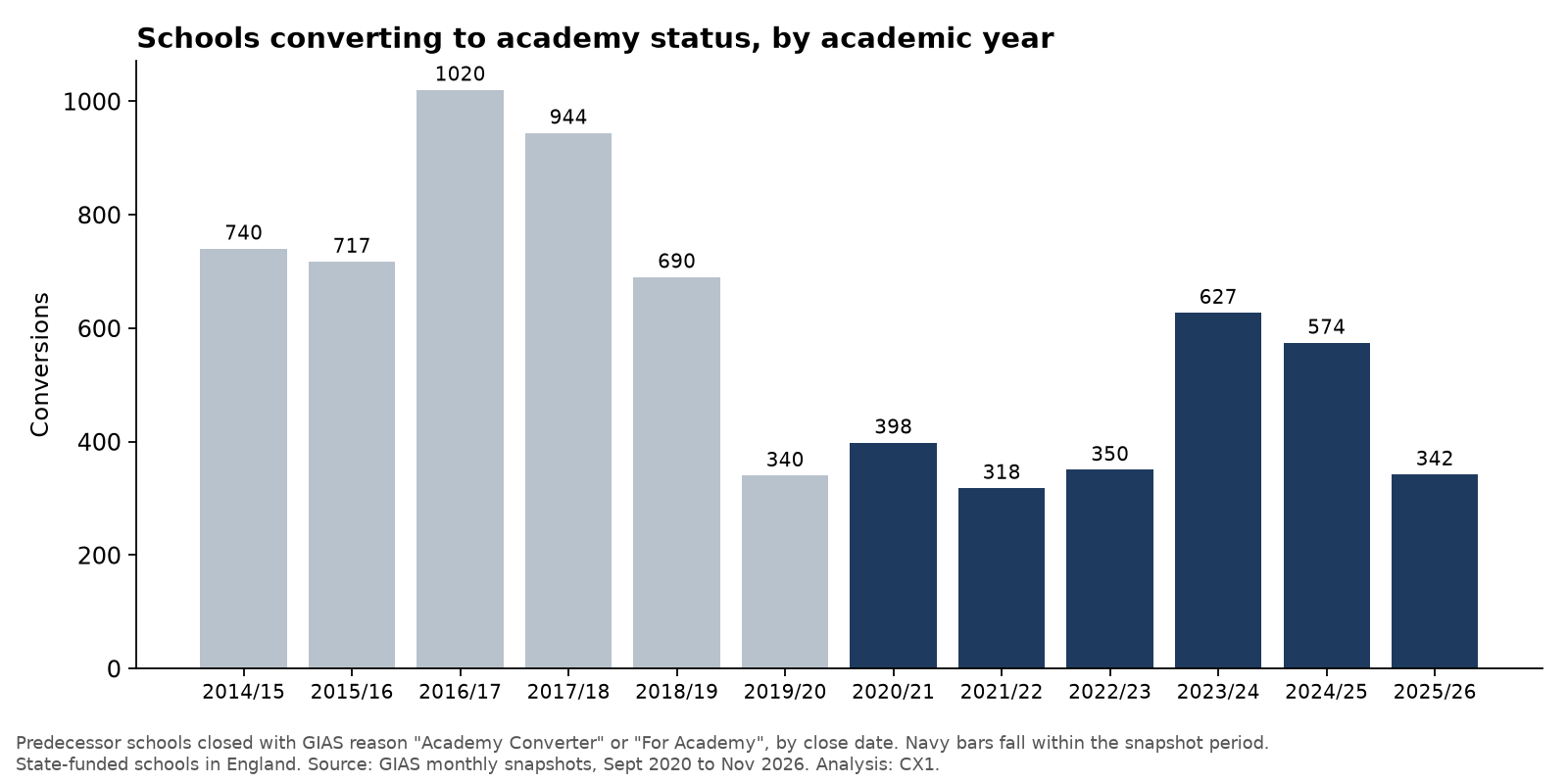
2,640 conversions, mostly primaries
Between 15 September 2020 and 26 November 2026, 2,640 schools converted to academy status. Most were primaries (2,281). There were 204 secondary conversions, 107 special schools and 39 pupil referral units or alternative provision settings.
| Academic year | Conversions |
|---|---|
| 2016/17 | 1,020 |
| 2019/20 | 340 |
| 2020/21 | 398 |
| 2021/22 | 318 |
| 2022/23 | 350 |
| 2023/24 | 627 |
| 2024/25 | 574 |
| 2025/26 | 342 |
The pace has varied a lot. Conversions reached 1,020 in 2016/17, then fell to a few hundred a year during and after the pandemic. They picked up to 627 in 2023/24 and 574 in 2024/25, then fell back to 342 in 2025/26, a drop of 40% in a year.
That fall coincides with a change in national policy after the July 2024 general election, including plans to end automatic academy orders for schools judged inadequate. GIAS records what happened, not why, so we cannot say how much of the drop is down to policy and how much to schools and trusts deciding to wait.
Primaries cross the halfway mark
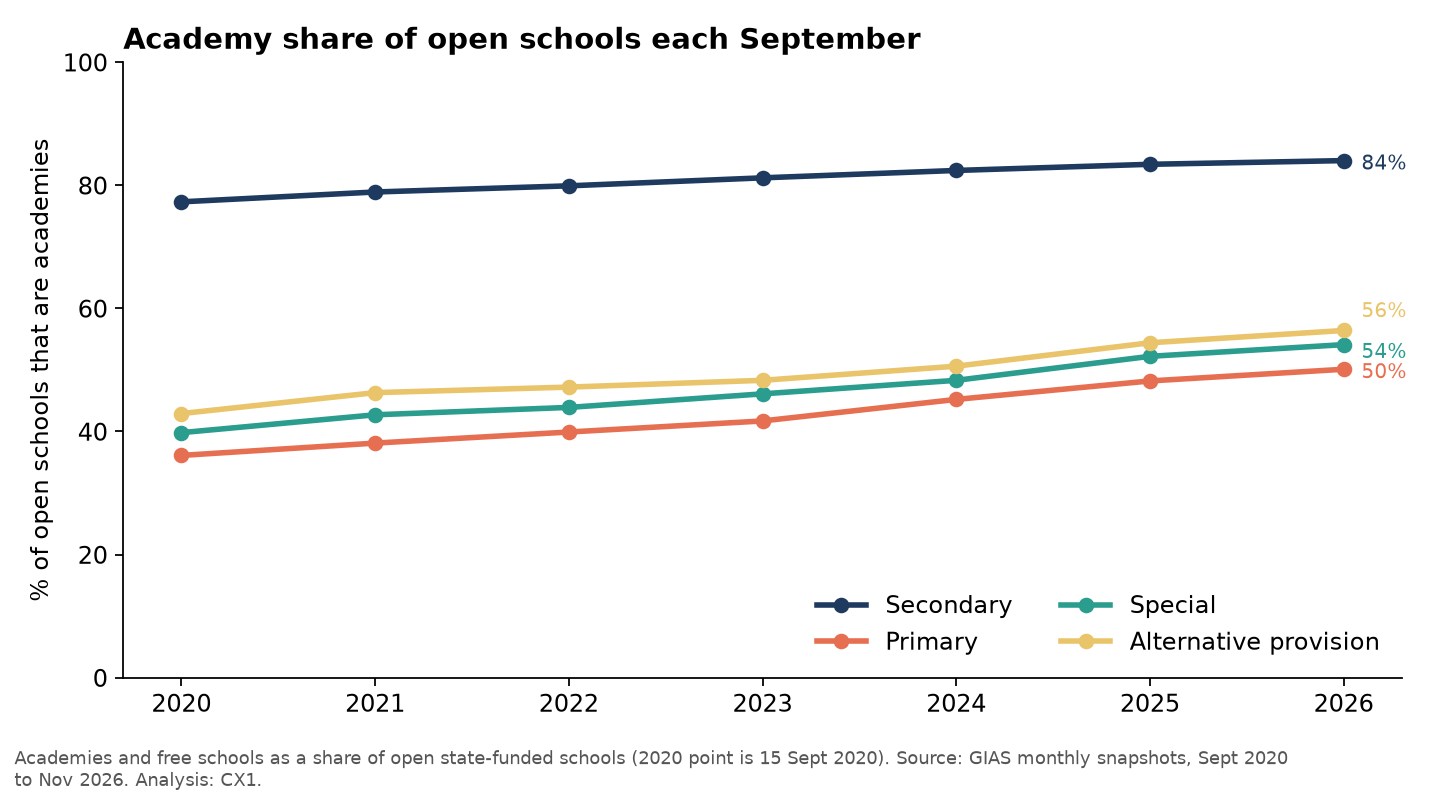
Secondary schools academised early: 77.3% were academies in September 2020. That has crept up to 84.0%. The bigger change has been in primary, special and alternative provision.
- Primary: 36.1% academies in September 2020, 50.1% in September 2026
- Special: 39.8% to 54.1%
- Alternative provision and pupil referral units: 42.9% to 56.4%
In September 2020 there were 12,681 maintained schools and 9,303 academies. By November 2026 there were 9,840 maintained schools and 12,106 academies.
Catholic primaries have moved fastest
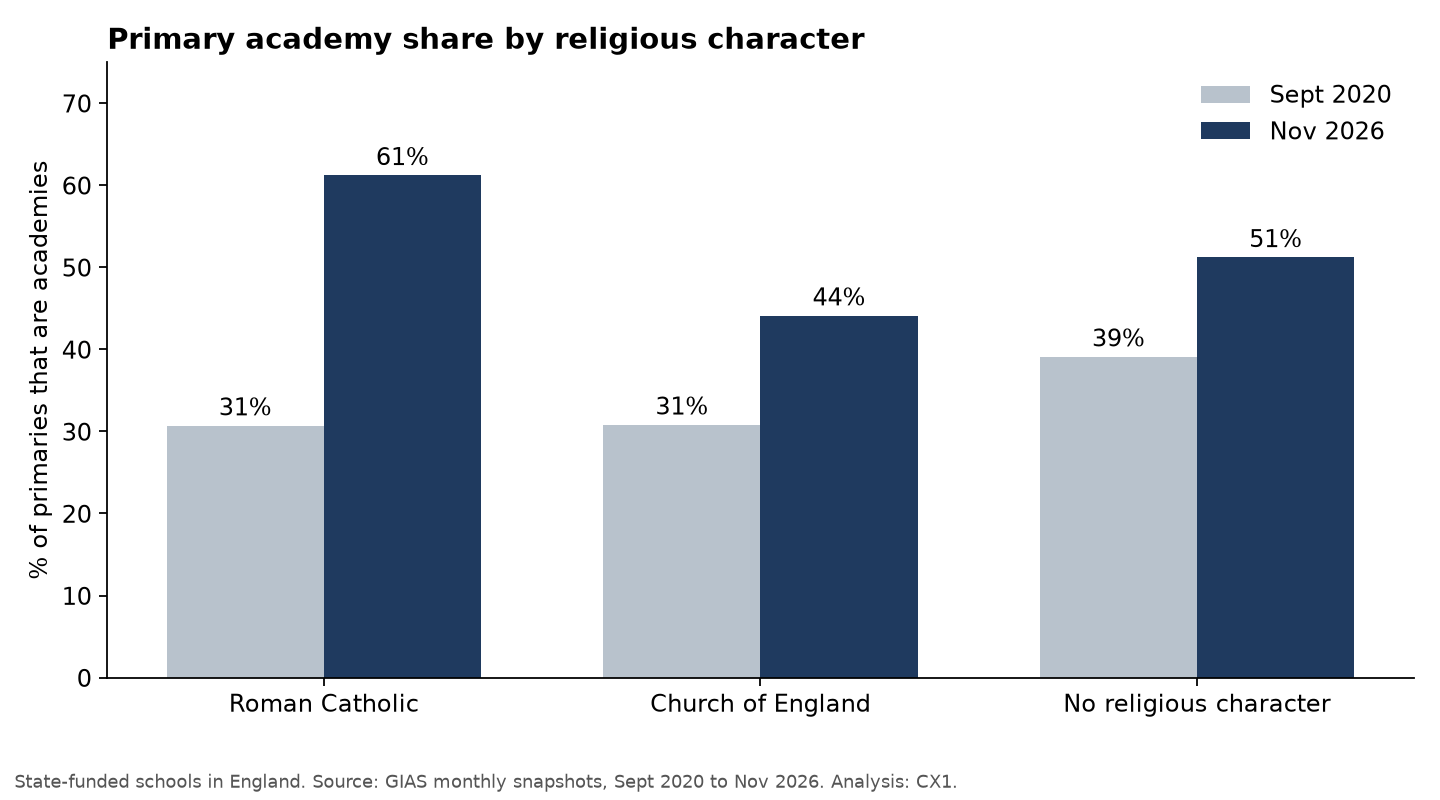
The most striking change is among faith schools. In September 2020, 30.7% of Catholic primaries were academies, almost exactly the same as Church of England primaries (30.8%). By November 2026, 61.2% of Catholic primaries were academies, against 44.1% for Church of England primaries and 51.2% for primaries with no religious character.
This is likely to reflect decisions by Catholic dioceses to bring their schools into diocesan trusts. Several of the fastest-growing trusts in England since 2020 are Catholic trusts, including St Gabriel the Archangel Catholic Multi-Academy Trust, which grew from 15 to 64 schools.
A very uneven map
| Region | Academies, Sept 2020 | Academies, Nov 2026 |
|---|---|---|
| South West | 55.6% | 69.8% |
| West Midlands | 46.8% | 63.5% |
| East Midlands | 51.4% | 62.0% |
| Yorkshire and the Humber | 48.3% | 61.8% |
| North East | 37.4% | 59.7% |
| East of England | 50.7% | 59.4% |
| South East | 36.7% | 48.1% |
| London | 36.9% | 43.3% |
| North West | 24.3% | 40.7% |
The North East changed most, up 22.3 percentage points. London changed least, up 6.4 points. Within regions the differences are much larger. Among local authorities with at least 40 open schools, Hull (99.0%), Thurrock (98.2%) and Bromley (96.0%) are almost entirely academies. Camden (8.8%), Hampshire (17.5%), Brighton and Hove (18.0%) and Lancashire (21.7%) remain mostly maintained.
Rural village schools have also moved quickly, from 30.9% academies to 45.0%, while inner London remains the least academised area type at 34.4%.
What this means for pupils, staff and boards
For pupils, the type of school matters less than its quality and stability. But conversion is a moment of change. A new trust can bring new curriculum materials, policies and leadership, and our analysis of headteacher change found that new academies were about twice as likely as established schools to record a new head within their first year.
For staff, conversion usually means a new employer under TUPE, new policies and sometimes new pay and conditions over time. Staff in a converting school deserve clear, early information.
For boards, the map now looks settled in some places and wide open in others. In local authorities where almost every school is an academy, the council's role in school improvement is now much smaller. In places like Camden or Hampshire, maintained schools remain the norm and councils still carry the main support role. The slowdown in 2025/26 means many maintained schools are likely to stay maintained for some time. Questions worth asking:
- If we are maintained, what support do we get from our local authority and is it sustainable as the maintained sector shrinks around us?
- If we are considering joining a trust, what would change for pupils in the first year, and how would we protect continuity of leadership?
- If we are already in a trust, how much of our improvement plan depends on the trust and how much on the school?
- For faith schools, what is our diocese's plan, and what does it mean for our timetable and choice of trust?
England now has a mixed system that looks likely to stay mixed. Boards on both sides of the line need to plan for that.
Methodology and limitations
Conversions are predecessor schools that GIAS records as closed with the reason "Academy Converter" or "For Academy", counted by close date and academic year (September to August). Earlier years come from closed records still held in GIAS. Academy shares count academies and free schools as a share of open state-funded schools in England on 1 September each year (15 September in 2020), using GIAS open and close dates. Pupil shares use the January census figures recorded in GIAS. Religious character, region and local authority are each school's current GIAS values.
A conversion closes one GIAS record and opens another, so counts are of conversions, not of pupils or sites. A small number of conversions dated after November 2026 may already be planned and are not counted. Our monthly change log, from 15 September 2020 to 26 November 2026, does not include a direct comparison between September and October 2023, but the conversion counts here come from GIAS dates rather than from that comparison, so they are unaffected.